Focus group meeting on future competence, feed and circular economy in the seafood industry
Together for sustainable solutions within the circular economy and new feed ingredients
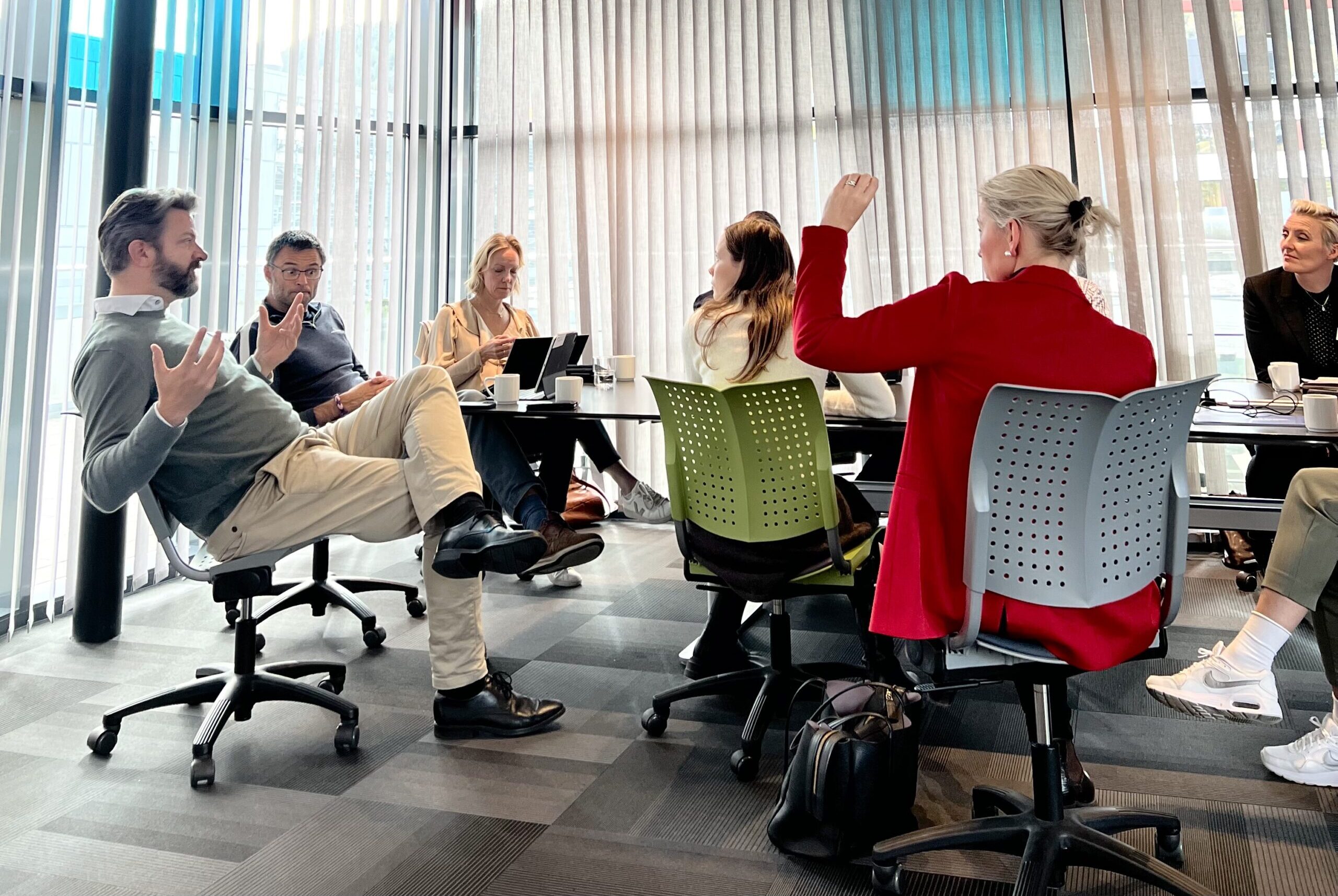
The need for collaboration to achieve sustainable solutions is increasingly important, especially in the circular economy and feed ingredients. On October 2, we therefore brought together the focus group for circular economy and the group for feed for a joint meeting, chaired by Solveig Holm. This meeting focused on how we can address challenges related to sustainability, and how we can utilize bioresources more efficiently in the industry.

Common goals for future solutions
Experts from our member companies and partners participated in an engaging conversation on how we can solve challenges related to establishing circular value chains and developing sustainable feed solutions. Among other things, it was highlighted how algae can be a valuable bioresource for both food production and feed, and how one must balance sustainability and efficiency in resource use. Participants agreed that it is urgent to take action, and that we only have a few years to achieve the ambitious climate goals we have set.
Norway's advantages in feed production
Members shared their perspectives on how Norwegian players have an advantage when it comes to the production of sustainable feed ingredients. They emphasized that Norway has unique opportunities through the cultivation of safe biomass, especially algae, which can help reduce the industry's carbon footprint. At the same time, it was pointed out that it is important to ensure that we develop ingredients that are not only sustainable, but also effective and economically profitable.
Cross-sectoral collaboration
The meeting also highlighted the need to connect different sectors to ensure holistic solutions. The cluster has an important role in creating arenas where different actors can meet, exchange experiences and work together towards common goals. Participants discussed regulatory challenges related to the utilization of sludge and phosphorus, and how best to address these in future projects.


The way forward
The cluster will continue to work purposefully to contribute to the development of sustainable solutions in the aquaculture industry. We will focus on including more relevant stakeholders in the discussions.
Together for future talents: Focus group meeting for future competence and talent attraction
On October 2nd, we also gathered the focus group for talent attraction for a meeting led by Fride Iversen. The meeting aimed to further develop and strengthen initiatives for future-oriented competence in the seafood industry. With participants from various players in the industry, it was discussed how we can attract and retain young talent in an industry that constantly needs new knowledge and competence.
What have we done, and where do we want to go?
The meeting opened with an update on several ongoing talent attraction initiatives, including the success of the Seafood Case Days pilot project and the new career site CVideo. The initiatives have yielded good results locally, but participants pointed out that there is still potential for growth at a national level.
Seafood Case Days: A new approach to real challenges
Seafood Case Days have already gained attention as a valuable initiative for both students and companies. In a pilot project, Lerøy and NHH students were challenged to solve real-world problems, such as maintenance challenges with submersible cages. Throughout the day, the students were able to delve into the issues, and their innovative solutions were appreciated by Lerøy's innovation department.
Participants agreed that these types of events not only provide valuable solutions to companies, but also make companies more attractive to young talent. As one student put it: “Companies that give students the opportunity to work on real cases become more attractive.”
Learning for all levels
The discussion also revolved around adapting competence development to different target groups, from primary school students to vocational students and academics.
Companies pointed out, among other things, that it is important to focus on those with trade certificates and vocational education, as they represent a large part of the workforce in production. Furthermore, several emphasized the need to focus on recruitment for vocational subjects, as there is a downward trend in the number of students choosing such education. Several of the companies said that they have found it necessary to train many unskilled workers internally to fill positions in areas such as production and receiving.


The Seafood Next competence program
With increasing demand for skills development , Seafood Next , a program aimed at further learning, has been scaled up. A company employee who previously participated in the program expressed: “This skills program is incredibly educational. We get the opportunity to learn both from experts in the industry and from each other, which provides both personal development and a strong network.”
The way forward
The meeting concluded with a shared understanding that the seafood industry has the potential to become even more attractive to young talent, but that it requires a coordinated effort. The focus group will continue to work to facilitate talent attraction at all levels, from school students to experienced professionals.
The focus groups
The focus groups have played a key role in identifying key priorities for the seafood industry. NCE Seafood will continue to collaborate with industry experts to create innovative solutions in both competency development and sustainability. Below you will find more information about the focus group meetings and their members.