Little knowledge about what salmon eat
Did you know that about 70 percent of the feed for farmed salmon consists of plants? If not, you're in good, international company.
A consumer survey in two of the largest markets for Norwegian farmed salmon reveals that consumers have little knowledge of what the popular Norwegian export product eats.
However, many of those who eat Norwegian farmed salmon agree on one thing: chicken ingredients in the salmon's feed are unnatural.
– This shows that we need better communication that explains to consumers what the feed actually consists of, and how it is developed. This is the main focus in the next phase of the project “Utilization of residual raw materials from chicken as a protein source in salmon feed”, says market researcher Morten Heide at Nofima.
The study was conducted by Nofima researchers Morten Heide and Florent Govaerts.
Lots to gain from good information
By 2034, all feed for farmed fish must come from sustainable sources. To increase Norway's self-sufficiency in salmon production, the proportion of Norwegian-produced raw materials in the feed must increase from 8 to 25 percent in accordance with the government's social mission on sustainable feed. Finding suitable protein sources produced in Norway is a challenge for the aquaculture industry. From that perspective, residual raw materials from chicken production are a relevant protein source – even though there are not enough Norwegian chicken resources to cover the need for protein sources in salmon feed.
The main objective of the consumer survey was to investigate consumers' perceptions of what salmon and farmed salmon eat. The second objective was to investigate how consumers perceive salmon feed with chicken ingredients, compared to four other types of feed ingredients – fish, algae, plants and insects. And what kind of perception consumers have about Norwegian farmed salmon when no information about the feed is provided.
– We looked at how consumers perceive salmon feed. And how different ingredients affect attitudes, acceptance and willingness to eat salmon, summarizes Florent Govaerts.
The conclusion is that because people know little about feed ingredients and react differently to them, new feed solutions must be explained in a clear and trust-building way.
Plant-based ingredients, which in reality make up around 70 percent of salmon's feed, were rarely mentioned when consumers in France and England were asked what they think salmon eat.
– This indicates that consumers are not very aware of the large proportion of plant-based raw materials that are included in modern salmon feed, the researcher points out.
When feed ingredients are not disclosed, salmon is viewed more positively. Specific ingredients often cause more negative reactions.
– Fish, algae and plants are perceived as natural and healthy. Insects give mixed reactions. And chicken arouses strong skepticism and is associated with unnaturalness and disgust, says Florent Govaerts.
Method:
-
- The data is based on an online consumer survey conducted among experienced salmon eaters and those responsible for purchasing in households that eat salmon on average 2–3 times per month.
- The survey was conducted in two rounds, one month apart. This was to reduce the possibility that effects or impressions from an earlier question influenced how participants answered later questions. In professional terms, this is called carry-over effects. Only those who completed both questionnaires are included in the analysis.
- The questionnaires combined open-ended questions with standardized scales. A 7-point rating scale from very negative to very positive. This allowed the researchers to measure attitudes, perceived healthiness and environmental impact. And to map acceptance and intention to eat salmon with different feed ingredients.
- The open-ended responses were grouped into themes. The closed-ended responses were examined with statistical tests, which check distribution and differences between the groups.
Exploratory approach
For the consumer researchers at Nofima, the method used to map consumer perceptions is important. It should not in any way influence the answers of those participating in the survey. An exploratory approach, with open questions, was therefore used.
“Open-ended questions ensure that consumers' own thoughts and associations to the topic are captured without being shaped by predefined criteria. This is especially important when trying to understand consumer reactions in unfamiliar situations,” says Morten Heide.
– We also measured consumers' attitudes towards eating salmon – without any information about feed – using the same scale, which in professional terms we call a semantic differential scale, he adds.
Similarly, the consumer survey assessed how participants perceived healthiness, environmental impact, and how acceptable the salmon was as food when fed with the various feed ingredients.
The knowledge the study resulted in, summarized:
-
- Limited knowledge about salmon feed: Many people know little about what farmed salmon eat. They rarely mention vegetable ingredients, even though they make up around 70 percent of the feed.
- Misconceptions about antibiotics and chemicals: The use of antibiotics in Norwegian salmon farming is now very low, less than 1 percent. Yet many people still associate farmed salmon with antibiotics and chemicals.
- Information about feed influences reactions: When people do not know what the feed contains, they evaluate the salmon more positively. They perceive it as healthier, more acceptable and are more inclined to eat it. Information about feed ingredients, without an explanation of why they are used (for example, considerations of sustainability, fish health or food safety), can create skepticism. For the industry, this presents a dilemma. Transparency is important, but must be combined with simple and trust-building information.
- Acceptance of different feed ingredients: Fish, plants and algae were rated most positively. Many perceive these ingredients as natural and healthy for the salmon. Insects were rated more negatively, especially in France. Chicken was rated by far the most negatively, and is associated with something unnatural, disgusting and of poor quality. Such ingredients may therefore encounter strong resistance in the market.
- Differences between France and the UK: British consumers were more open to new feed sources such as insects and chicken. French consumers were more skeptical of such ingredients. Therefore, both communication and product development should be adapted to each country.
- Information and views on chicken in salmon feed: Many were skeptical about some ingredients, especially chicken. At the same time, several were surprised or unsure when they heard about new feed sources. This suggests that attitudes can be changed with targeted and trust-building information.
Facts about the research
-
- The consumer survey was conducted in France and England.
- Over 1,000 participated in the survey.
- France and England are two important salmon markets in Europe with exports of 100,000 tonnes and 60,000 tonnes respectively in 2024.
- The study is funded by FHF – Fisheries and Aquaculture Industry Research Funding. It is carried out as a collaboration between Nofima, The Seafood Innovation Cluster AS, MOWI and Nutrimar in the project “ Utilization of residual raw materials from chicken as a protein source in salmon feed ”.
Utilization of leftover raw materials from chicken as a protein source in salmon feed
-
- The goal of this project is to facilitate increased utilization of chicken waste products in salmon feed.
- Time frame: 2024 – 2027
- Funded by the Fisheries and Aquaculture Industry Research Funding (FHF)
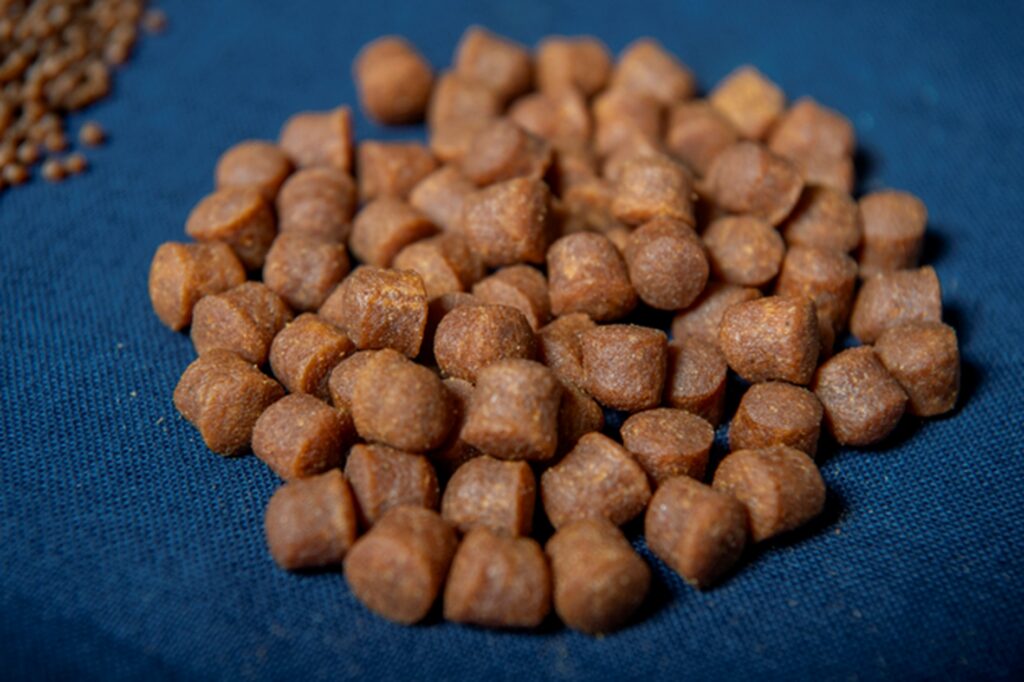 Consumers in England and France have little knowledge about what salmon feed consists of. Photo: Helge Skodvin, Nofima.