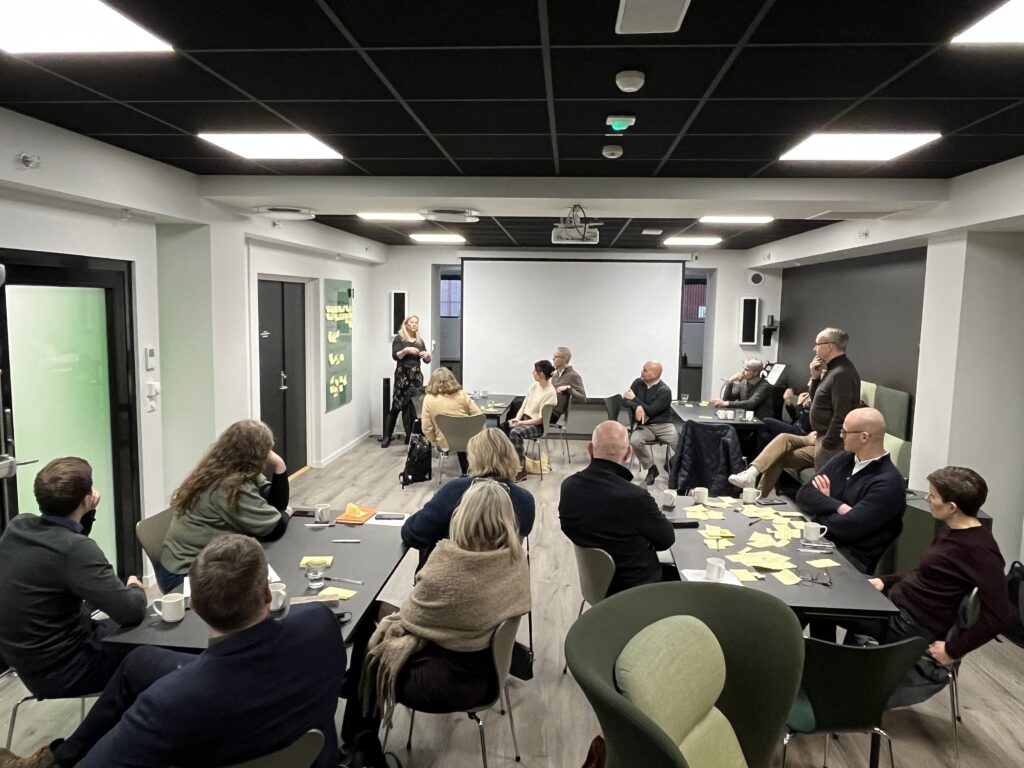
PicMonkey Collage5 In collaboration with the Norwegian Seafood Center, we invited to Sats Marint at Scandic Bergen City on March 15-16. Sustainable growth in the aquaculture industry depends not only on increased production of salmon and trout, but also on new species, new technological solutions and new ways of farming the sea. What is needed for these species to provide the basis for jobs along the coast, and how can land-based farming provide new opportunities for both salmon and marine species?
There is already both knowledge and experience with other species and work is being done on several fronts to ensure that new species can become commercial industries. A great deal of effort has been made by both public and private actors on species such as halibut, turbot, cod, catfish, bream and roach. In addition, there are shellfish and kelp.
This year, Sats Marint went broad with a focus on the farming and cultivation of marine species. The main focus was primarily on halibut, cod, algae and technology in land-based farming, but the status of catfish, roach, rock gilthead, king and snow crab was also presented. We were presented with a lot of new information, especially within the farming of halibut and the development of land-based farming facilities. Among other things, it seems that the farming of halibut is facing a more stable future, and the potential within land-based farming is great.
Honorary Award of the Year
During Sats Marint, an honorary award is awarded annually to a person who has made a great contribution to the industry in the past year. Two honorary awards were presented during this year's conference. The honorary award for 2017 went to Kristin Hamre from NIFES for her contribution to marine fish farming. The award for 2016 went to the general manager of the Norwegian Seafood Center, Grethe Adoff.
The presentations from the conference can be found here.
Highlights from the program:
Mussels
Grethe Adoff from the Norwegian Seafood Center opened this year's Sats Marint conference in Bergen with, among other things, the status of mussel production in the country. Adoff pointed out that in 2015, mussel production was close to 2,000 tons, but that it has since been halved. Today, we have production of less than 1,000 tons. She said that the farmers believe that it is expensive to test the mussels for toxins if they pay the entire bill themselves. At the same time, she points out that the market and prices are good, so the opportunities are still good in mussel farming.
Halibut and kelp
Grethe Adoff, general manager at the Norwegian Seafood Center, points out that the production of fry and the quality of halibut fry have improved a lot in recent years. Sterling White Halibut has new owners who want to continue the halibut farming, in addition to Sogn Aqua, which has made significant investments in modern production facilities. In the area of kelp, she believes that they have gained their own network of farmers, and they are also looking at the possibility of salmon farmers farming kelp on the side.
Roe crackers and Berggyte
Erlend Waatevik from EWA Consulting estimates that the production of roach in 2017 will exceed 30 million. This will overtake rainbow trout as Norway's second most farmed species in terms of numbers. He estimates that the production of rock gilts will be significantly lower. Last year, he estimated a production of about 1.5 million rock gilts. For 2017, he estimates the production to be two to three million.
Cod
Atle Mortensen from Nofima's Aquaculture Station in Tromsø discussed the status of cod farming during Sats Marint in Bergen, and said that the premises for cod farming have never been better than they are now. He claims that the problems with escapes, deformities and uneven growth that have existed in the past are almost non-existent anymore.