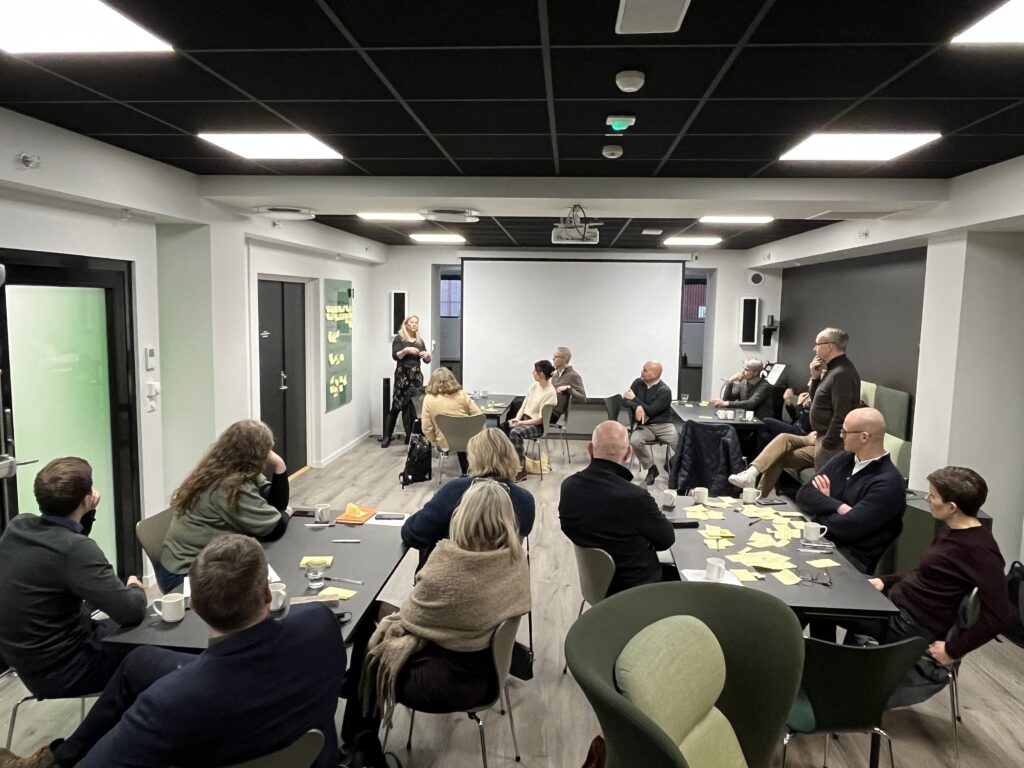
BigData_ppt The workshop focused on the need to share information and data to solve the challenges facing the industry.
Artificial intelligence
Big Data is scaling, sharing and speed, according to Klaus Johannsen, research director at the Center for Big Data Analysis at Uni Research Computing.
Data collection, much of it from open sources, is fed into artificial intelligence for decision support. The data can be obtained from sources such as the Norwegian Meteorological Institute, Lusedata, satellites and information about ocean currents. An example of this is the salmon lice model of the Institute of Marine Research.
– It is one thing to predict reality, another thing to understand it, Johannsen points out in front of a hundred people gathered in the Royal Hall at the Radisson Blue Bryggen in Bergen.
Good enough knowledge
Aud Skrudland, a special inspector at the Norwegian Food Safety Authority, has access to extensive data collection of lice data from the fish farming companies. But she calls for the right knowledge from them.
– We do not have sufficient knowledge about measures such as vaccines against PD. We have the same for health food. We do not have good enough data for breeding programs aimed at preventing various diseases. We know far too little about the reasons why fish die. We do not have good enough knowledge, and cannot direct measures against it, she says.
– Farming companies must be able to document their goals to a greater extent, have measures to achieve the goals, and if the goals are not reached, they must have a system for being included in a positive improvement culture.
Very simple
– When it comes to lice, the impact that sea lice have on wild fish will determine whether the aquaculture industry will be allowed to grow or not. This will also have an impact on our management.
Skrudland further points out that extensive resources are used to count lice.
– We need new methods for counting lice. There are challenges in relation to fish welfare, and it is challenging to count the fish. What is important to us is that the count is correct, she says, and calls for counting significantly more fish and more frequently.
– Today's count is, it might be wrong to say primitive, but at least very simple, says Skrudland.
Text by Aslak Bergen, ilaks.no